



luxury must be preserved
rethinking the luxury textile program
Prefer to read offline? Download the pdf
In luxury hospitality, creating an exceptional experience is only the beginning.
The greater challenge is preserving it.
Every detail contributes to the way a guest experiences a property, but few are as personal, or encountered for as long, as the textiles they touch throughout their stay. Yet these highly experiential products are often managed through individual categories and decisions rather than considered as part of the complete guest experience.
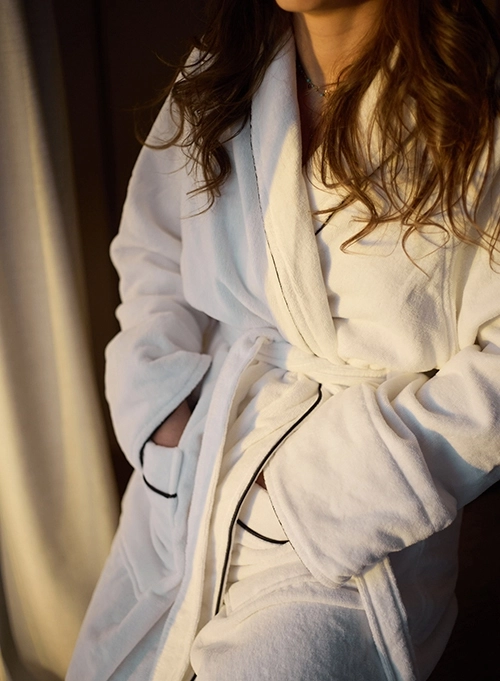
Some of the most personal moments of a hotel stay are also the most tactile. The quality of sleep, the comfort of a towel after bathing, the feel of a robe, or the relaxation of a poolside experience all contribute to how a guest feels cared for, and ultimately, how they remember the property.
Guests rarely analyze a property’s textile program consciously, but they know how the experience made them feel. From the bed to the bath, from the spa to the pool, each tactile interaction contributes to an overall perception of comfort, quality, and care.
When those experiences align, they reinforce trust in the brand. When they do not, the disconnect may be subtle, but it is still felt.
The challenge is not simply creating an exceptional first impression. It is sustaining that experience throughout the stay and delivering it with the same care across every stay that follows, despite the realities of repeated use, commercial laundering, replenishment, and daily operations.
Architecture, design, culinary experiences, service, and a sense of place each contribute to a property’s identity. Textiles add another dimension to that experience: they make comfort, quality, and care tangible through touch. Each sheet, towel, robe, and spa textile becomes part of the way the guest physically experiences the property.
Preserving an exceptional guest experience requires a broader view of the textile program, one that connects product design with hospitality performance, laundering expertise, replenishment planning, lifecycle management, and disciplined execution. Together, these elements create the operational foundation needed to sustain quality and consistency over time.
Viewed this way, a luxury textile program is more than a collection of products. It is an operating discipline that helps translate brand standards into a guest experience that can be delivered consistently over time.
“Luxury brands invest years creating standards that guests come to trust. Protecting those standards requires more than exceptional products.
It requires the discipline, expertise, and long-term stewardship to deliver the same experience, property after property and stay after stay.”
Gary Heiman
Chairman & CEO, Standard Textile
protecting the brand promise
“Guests don’t experience textiles as separate products. They experience one continuous expression of the brand. Every sheet, towel, robe, and spa linen should reinforce the same standard of comfort, craftsmanship, and care.”
François Roblin, General Manager, Europe
Luxury hospitality is built through countless moments, some highly visible, others almost unnoticed. Design, service, dining, wellness, and sense of place all contribute to a property’s identity and to the expectations guests bring to every stay.
What ultimately builds trust is whether the standard of quality and care remains recognizable throughout a guest’s stay, and across the stays that follow.
Sustaining that consistency becomes more complex once a textile program enters daily operation. Products begin interacting with repeated guest use, commercial laundering, housekeeping practices, replenishment cycles, regional conditions, and the realities of property operations.
Guests do not separate the performance of a textile from the experience of the property. As its feel, appearance, and presentation change over time, those changes can influence perceptions of comfort, quality, and attention to detail. Every interaction with a sheet, towel, robe, or spa textile has the potential to reinforce the standard the brand has established.
For this reason, textiles can become one of the most tangible expressions of a property’s standards. They translate design intent, comfort, and care into something guests experience physically, helping the character of the property remain recognizable from one stay to the next.
Consistency, however, should not be confused with uniformity. For a global luxury brand, each property should retain its own character and sense of place while still expressing a recognizable commitment to quality, comfort, and care. The role of the textile program is to support both.
Consistency is what turns a brand promise into lasting trust.
laundry is the real test of luxury
Luxury is designed in the studio. It is preserved in the laundry.
A textile program and a laundry program are not separate decisions. They are parts of the same operating system. The way textiles are specified, inventoried, laundered, handled, and replenished ultimately influences how successfully a property can maintain its standards over time.
A sheet that feels exceptional when it arrives at a property has passed only its first test. A towel that presents beautifully at installation must still sustain that experience through repeated guest use and commercial laundering. Long-term performance is what ultimately determines whether the original standard can be preserved.
Every laundering cycle introduces variables that can influence textile performance. Water quality, chemistry, extraction methods, drying temperatures, handling procedures, storage conditions, and operating practices all affect appearance, hand, dimensional stability, and longevity.
Inventory management is equally important. When properties operate below recommended PAR levels, textiles may return to service more quickly, reducing the opportunity for proper processing, recovery, and rotation. Over time, that can contribute to accelerated wear, shorter product life, and greater operational pressure.
Luxury cannot be maintained when the system supporting it is under constant constraint.
The finest textile cannot compensate for poor laundering practices, just as exceptional laundering cannot overcome poor product construction. Luxury is preserved when product design and operational execution work together.
Guests may never see a hotel’s laundry operation, but they experience its results every day. Changes in softness, whiteness, absorbency, appearance, or presentation may originate in the product, the process, or the interaction between the two. Understanding that distinction is essential to protecting performance over time.
Changes in textile performance typically develop over time through repeated interaction with water, chemistry, temperature, equipment, handling, and use. Identifying those changes early creates an opportunity to address the underlying cause before performance moves materially away from the intended standard.
A disciplined textile program therefore incorporates laundry governance alongside product selection. In practice, this may include region-specific processing guidance, chemical compatibility review, performance monitoring, troubleshooting, and ongoing collaboration with property and laundry teams to help maintain the intended standard over time.
This approach shifts the conversation from replacement to preservation. Rather than responding only when performance declines, teams can focus on preserving softness, appearance, absorbency, dimensional stability, and presentation throughout the product lifecycle.
Consistent execution helps protect the integrity of the guest experience. A standard shaped by brand leaders, ownership, designers, and operators must ultimately be supported by the daily processes and people responsible for bringing it to life. The people who launder, inspect, handle, store, and present these products are therefore essential partners in preserving the standard.
The best textile systems support their work with products, processes, training, and technical guidance designed for the realities of hospitality operations. The laundry operation may be largely invisible to guests, but its influence is present in every room, every towel, every robe, and every night of sleep.
“Commercial laundering doesn’t create quality—it reveals it. The best textile programs are engineered to perform long after installation.”
Ken Kaiser
Director, Regulatory & Technical Services
one guest experience. one textile program.
“The strongest luxury textile programs are designed holistically. They consider how guests move through the property and how each tactile interaction contributes to a unified perception of the brand.”
Judy Sroufe, Global Brand Leader, Mascioni Hotel Collection
Every interaction with the bed, bath, spa, and pool contributes to a broader impression of the brand. The luxury textile program should be managed with the same continuity.
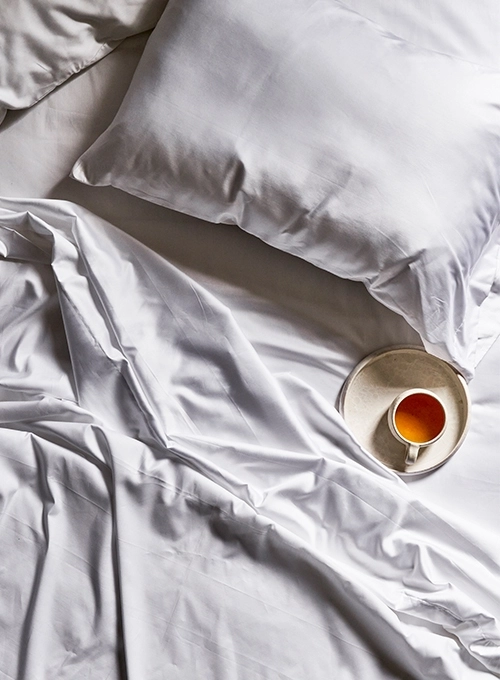
A guest sleeps in the bed, showers in the bathroom, wraps themselves in a robe, visits the spa, lounges by the pool, and returns to their room. Throughout that journey, each tactile interaction contributes to their perception of comfort, quality, and care.
Different textile categories may require different products, constructions, or sourcing solutions. What matters to the guest is not how those decisions are structured, but whether the experience feels intentional, cohesive, and consistent with the property’s standard.
Luxury brands work tirelessly to create a coherent identity. Inconsistency in the tactile experience can quietly work against that effort. A robe that feels exceptional beside a less considered bath towel, or an extraordinary spa experience followed by guest-room textiles that feel disconnected from that standard, can create subtle moments of inconsistency. Guests may never identify the source, but they recognize when the experience no longer feels cohesive.
This level of cohesion becomes increasingly important as luxury hospitality continues to evolve toward highly differentiated, design-led experiences. That continuity transforms individual products into a unified brand experience. Achieving it requires hundreds of technical decisions that remain invisible to the guest but shape every interaction they have with the property.
Guests rarely evaluate thread count, fabric weight, yarn construction, or fiber selection. They evaluate how the experience makes them feel.
Every luxury hotel has a visual identity. Increasingly, the most memorable properties also possess something less obvious: a tactile identity. It is expressed through the feel of the bed, the drape of the sheets, the weight of a towel, the comfort of a robe, and the continuity of those experiences throughout the property.
This becomes especially important as luxury properties invest in distinctive design and highly personalized experiences. The textiles selected for a property should reinforce that vision, carrying the same design language, aesthetic cues, and tactile expectations from the guest room to the spa and pool.
For luxury properties with a strong sense of place, customization can play an equally important role. Bespoke detailing, embroidery, color palettes, and custom textile solutions help reinforce a property’s unique identity. A carefully selected embellishment, border detail, or custom finish can communicate as much about a property’s character as a piece of furniture or artwork.
However, customization must be balanced with operational realities. A customized textile program that cannot maintain its appearance, softness, or performance over time ultimately undermines the very experience it was designed to support. Design intent does not end when a property opens. Customization is only valuable if it survives daily hospitality operations.
When executed successfully, guests rarely notice this cohesion because it feels natural. When it is absent, however, the disconnect can become visible.
Luxury brands invest enormous effort in creating a distinctive identity. The textile program is one of the systems capable of reinforcing that identity every single day. The strongest luxury textile programs are managed as one integrated system supporting one seamless brand experience.
luxury must be designed for hospitality
Residential luxury and hospitality luxury ask very different things of a textile.
Many of the world’s most recognizable luxury linen brands originated in residential markets, where products are used under entirely different conditions. A luxury home sheet may be laundered once every week or two. A hotel sheet is laundered far more frequently.
Luxury hospitality is its own engineering discipline because textiles must survive commercial operations. That requires different development decisions, different manufacturing priorities, and different performance standards.
A product that feels exceptional in a showroom may perform very differently after repeated commercial laundering cycles. This is why hand feel and aesthetics should be considered alongside construction, processing, testing, and long-term hospitality performance.
Premium raw materials remain essential, but hospitality luxury is measured by how well those qualities are sustained through repeated guest stays, commercial laundering, and daily use.
In residential environments, textiles are often evaluated primarily through the lens of personal preference. Hospitality operators, however, must balance guest expectations with operational realities. Products must feel exceptional to guests while also supporting the people responsible for delivering that experience: housekeeping teams, laundry operators, property leaders, procurement teams, and ownership.
Hospitality-first design therefore begins long before production. Fiber selection, weave construction, finishing techniques, embellishments, and performance specifications must all be developed with commercial hospitality in mind. Design integrity and operational durability cannot be treated as separate objectives.
This becomes especially important for luxury properties that rely on customized textiles to express their identity. Bespoke details and distinctive finishes help differentiate a property, but only if they withstand daily operations. When a customized textile no longer reflects the designer’s original intent, the disconnect can weaken the experience it was created to support.
Beautiful design that cannot withstand hospitality operations cannot fully support the brand it was created to express.
Hospitality-first luxury is not a product category. It is a design discipline. Every decision, from fiber to finish, must be made with real-world hospitality performance in mind.
the discipline behind luxury
“Quality isn’t something you inspect at the end of the process. It’s something you protect at every stage—from fiber selection and manufacturing to laundering, replenishment, and lifecycle management. Every decision either preserves the standard or slowly erodes it.”
Tim Wirrig, VP, Quality & Supply Chain Services
Luxury is often described as an art. Sustaining luxury is discipline. Every exceptional textile program is supported by craftsmanship, material science, manufacturing discipline, quality control, and laundering expertise.
The softness of a towel begins with fiber selection. The performance of a sheet begins with manufacturing standards. The longevity of a robe begins with construction decisions made long before the product reaches a property.
Guests experience luxury emotionally. Hotels preserve it through disciplined execution. Every standard a guest encounters is ultimately the result of thousands of decisions made long before they ever enter the room.
Achieving that alignment requires far more than purchasing exceptional products. It requires systems, standards, governance, and disciplined execution. Luxury is not maintained through procurement alone.
Ultimately, luxury brands are placing more than a textile order. They are placing trust in a partner’s ability to protect the standards those products represent. Conditions change, environments evolve, and challenges inevitably arise throughout the life of a textile program. Success depends on working with a partner that brings deep expertise in product design, laundering, lifecycle management, and long-term stewardship.
“Luxury textile programs succeed because of trust. Brands must be able to rely on partners with deep expertise in design, processing, and lifecycle stewardship. Conditions change, challenges arise, and standards evolve. The right partner brings the knowledge and experience to preserve those standards over time.”
Gary Heiman, Chairman & CEO, Standard Textile
Designing exceptional products is only the beginning. Protecting luxury standards requires governance: ensuring specifications, replenishment decisions, operational practices, and quality expectations remain aligned over time.
Without that discipline, even thoughtfully designed textile programs can drift through small substitutions, inconsistent replenishment, regional variations, and operational shortcuts.
Luxury is rarely compromised by a single decision. It is more often diminished by hundreds of small ones.
A luxury standard can be carefully defined at the brand level, but its success ultimately depends on how consistently it is brought to life at the property level. Housekeeping teams, laundry operators, procurement leaders, and property management all influence how successfully that standard is maintained. Luxury standards are ultimately brought to life by people. The strongest textile programs are designed not only for guests, but also for the teams responsible for handling, identifying, storing, laundering, and presenting those products every day.
The discipline behind luxury therefore extends beyond the product itself. It includes the systems, training, performance monitoring, and technical support required to protect brand integrity across properties, regions, and years of guest use.
For luxury hotels, consistency depends on how thoughtfully these variables are managed. This becomes increasingly important for global luxury brands operating across multiple properties, regional requirements, and diverse operating environments. A guest moving from Paris to Singapore, or Capri to Dubai, should encounter a recognizable commitment to comfort, craftsmanship, and care, even as each property may express its own identity and sense of place.
The most sophisticated luxury textile programs rely on rigorous validation processes to evaluate long-term performance. Shrinkage tolerances, tensile strength, and multi-cycle wash performance all help determine whether a product can support luxury standards over time. The objective is not simply creating a beautiful product. It is creating one capable of maintaining its integrity under hospitality conditions.
“Operational excellence is what allows luxury standards to endure. Products matter, but it is the discipline of the systems, processes, and people behind them that ensures every guest experiences the brand exactly as intended.”
Bradley Fry, Executive VP, COO & CFO
the economics of preservation
For luxury operators, acquisition cost is only one component of value.
Textile programs can be evaluated through the lens of both acquisition cost and long-term value. The two are related, but they are not always the same.
The true impact of a luxury textile program extends well beyond the initial purchase. Replacement frequency, inventory requirements, laundering demands, replenishment consistency, and program management all influence its long-term value.
A lower purchase price may be advantageous at acquisition, but if products require more frequent replacement, create inconsistencies across properties, or place additional strain on inventory and laundry operations, the long-term implications can be significant. Each replacement also creates another point at which the intended standard must be carefully maintained.
Luxury brands increasingly evaluate textile programs as long-term operating systems as well as individual purchases. In addition to acquisition cost, considerations may include replacement frequency, laundry impact, inventory requirements, replenishment consistency, and lifecycle performance.
The long-term value of a luxury textile program is ultimately shaped by how well it supports both operational performance and the standards the brand has established.
Luxury investments are best evaluated by both the value they create and the value they preserve and not by acquisition cost alone.
longevity is sustainability
Sustainability has become a defining priority in luxury hospitality.
One of the most meaningful sustainability attributes of a luxury textile is its ability to remain in service without premature replacement.
Every replacement cycle requires new raw materials, manufacturing resources, transportation, packaging, and the disposal of existing inventory. Products that require premature replacement can increase waste, operational complexity, and the resources required to manufacture and move replacement goods.
Extending useful product life can conserve resources while preserving the intended guest experience.
Luxury has always emphasized quality over disposability. The finest products are expected to endure. They are expected to maintain their integrity, appearance, and performance over time. Textiles should be no different.
Sustainability is not achieved through product specifications alone. It is achieved through education, proper care, technical support, and lifecycle management. These practices complement responsible sourcing, manufacturing, water stewardship, waste reduction, and circularity by helping extend the value of the resources already invested in the product.
Luxury hospitality brands are increasingly expanding their view beyond product longevity to the full lifecycle of textile assets. Stewardship does not end when a product reaches the end of its service within a property. It extends to how materials are repurposed, recycled, or reintroduced into future production, maximizing their value while reducing waste throughout the lifecycle.
This reflects a broader shift toward stewardship. Circularity is one expression of that philosophy, recognizing that textiles should be managed—not simply purchased and discarded. Just as luxury hotels steward their historic properties, natural surroundings, and brand standards, they can apply the same discipline to the materials that help define the guest experience.
Ultimately, sustainability is strongest when it becomes part of the daily operating model rather than a standalone initiative. When products remain exceptional longer, hotels preserve resources, reduce waste, and continue delivering the consistency guests expect.
In luxury hospitality, sustainability is shaped not only by what is purchased, but by how responsibly products are used, cared for, preserved, and managed throughout their lifecycle.
“Longevity is more than a durability metric. It is one of hospitality’s most effective sustainability strategies.”
Tim Wirrig
VP, Quality & Supply Chain Services
protecting luxury at global scale
“Across Europe, textile programs are often supported through long-standing partnerships with commercial laundries.
That model reinforces an important principle: protecting luxury isn’t simply about supplying exceptional products. It’s about working alongside the people responsible for preserving those products every day.”
François Roblin, General Manager, Europe
Luxury brands are built on trust. Guests choose them with the expectation of a consistently exceptional standard, regardless of where they are in the world.
Preserving that trust across a global portfolio requires both consistency and thoughtful adaptation.
Delivering on that expectation requires sensitivity to regional realities. Water quality, laundry processes, labor structures, and operational practices can vary significantly by market.
A luxury textile program that performs exceptionally in one region may require thoughtful adaptation in another. Certain constructions may work effectively in Europe while requiring different approaches in North America or Asia.
The objective is not to eliminate regional differences, but to preserve the brand standard through them. Luxury brands must create enough flexibility to accommodate regional realities while maintaining the consistency guests expect.
Luxury textile programs require far more than manufacturing capability. They require replenishment systems, inventory management, technical support, and the global expertise needed to preserve standards across multiple markets over time.
For groups managing large portfolios, complexity increases with every new property, operating environment, laundry partner, sourcing model, and regional requirement. Brand drift rarely begins with a single major decision. More often, it is the result of small variations that accumulate over time. Governance helps ensure those variations do not move the program away from the intended standard.
A luxury standard established at the brand level must ultimately be executed at the property level. Every hotel has its own leadership team, laundry operation, staffing realities, and regional requirements. Structured implementation and ongoing oversight help ensure that the program continues to reflect its original intent over time.
This is why global luxury brands increasingly seek partners capable of supporting not only product delivery but also program execution. Consistency depends on onboarding, replenishment planning, technical support, performance monitoring, and long-term stewardship—not simply the products themselves.
Equally important is infrastructure. Global luxury brands require confidence that products can be replenished consistently, specifications can be maintained over time, and supply chains can support growth without compromising standards. Reliability may be invisible to guests, but they experience its consequences every day.
Guests may never see the supply chain, but they experience the results of its performance. Consistent replenishment helps ensure that replacement products continue to reflect the intended feel, appearance, and standard of the property.
For hotels, this creates a powerful advantage. Design teams gain confidence that their vision can be maintained across multiple properties. Brand leaders gain confidence that standards can be executed consistently. Ownership gains confidence that investments in the brand can be protected over the long term.
Perhaps most importantly, global consistency should never be mistaken for uniformity. Guests do not expect every property within a portfolio to look identical. They expect each to express its own sense of place while delivering a recognizable standard of quality. The role of the textile program is to support both objectives simultaneously: preserving the individuality of the property while reinforcing trust in the brand.
Trust also extends to the relationship between the brand and its textile partner. Throughout the life of a luxury textile program, there will inevitably be moments of tension such as changes in operating conditions, supply challenges, evolving brand standards, and regional complexities.
The strongest programs succeed not because those challenges never arise, but because they are managed by partners with the expertise, experience, and credibility to navigate them successfully.
“Global luxury programs succeed when brand standards remain constant while implementation respects regional realities. The objective isn’t to make every market operate the same way.
The objective is to ensure every guest experiences the same level of luxury, wherever they stay.”
Patrick Zhu, Sales Director, Asia
redefining the luxury textile program
Luxury hospitality has evolved significantly over the past decade.
Guest expectations have risen. Brand standards have become more sophisticated. Operational pressures have intensified. Sustainability requirements have expanded. Global portfolios have become increasingly complex.
As luxury hospitality has evolved, the way textile programs are designed and managed must evolve with it.
Luxury hospitality increasingly requires a broader perspective. The question is not only how to select exceptional textiles, but how to preserve the experience they are intended to support under increasingly complex operating conditions.
Sheets, towels, robes, and spa textiles may be distinct product categories, but together they contribute to one guest experience.
An integrated textile program considers how those categories work as a system, supporting brand standards, operational performance, and continuity throughout the guest journey.
A modern luxury textile program integrates:
- Hospitality-first engineering
- Laundering expertise
- Inventory and demand planning
- Replenishment planning
- Lifecycle optimization
- Technical support
- Long-term program stewardship
- Most importantly, it aligns textile performance with the experience the brand has promised.
A luxury textile partnership can contribute far more than product delivery alone. The strongest textile partners combine product expertise with stewardship, helping brands protect consistency through implementation, training, replenishment, lifecycle management, and continuous performance support.
Increasingly, textiles can be viewed not only as procurement categories, but as strategic expressions of the guest experience. They influence comfort, presentation, and the way quality is physically experienced throughout the stay.
A modern luxury textile program is not defined by specifications alone. It is defined by its ability to preserve a property’s tactile identity while consistently delivering on the brand promise. Product selection remains important, but it is only one component of a successful program.
Equally important are implementation, training, replenishment, lifecycle management, and the systems required to sustain consistency over time.
For global luxury brands, the right textile partnership can support the entire lifecycle of the program, from design collaboration and product engineering through implementation, replenishment, and long-term performance management.
Luxury is not ultimately defined by what is specified. It is defined by what guests experience and preserved through disciplined stewardship.
“Luxury brands don’t build trust simply by creating exceptional experiences. They build trust by preserving those experiences over time. That requires more than exceptional products. It requires partners with the expertise, discipline, and commitment to protect the standards the brand has promised every guest.”
Gary Heiman
Chairman & CEO, Standard Textile
a new perspective
Every luxury brand makes a promise.
Every guest decides how that promise made them feel.
Luxury is built on trust.
Trust requires consistency.
Consistency requires stewardship.
Stewardship requires partnership.
A luxury textile program is more than a collection of products. It is one of the operating systems through which a hotel helps preserve the standards it has established for the guest experience.
Viewed this way, textiles can be considered not only as procurement categories, but as strategic assets that support the guest experience over time.
When textiles are managed with the same care, discipline, and long-term perspective applied to other elements of the guest experience, they can help preserve what matters most: consistent quality, trust in the brand, and an experience guests look forward to returning to.
Prefer to read offline? Download the pdf